

Destination
Zadar from Split
Zadar is a Roman-founded city on the northern Dalmatian coast, known for the Sea Organ and the Greeting to the Sun on its waterfront, and for a compact old town built over a Roman forum.
About Zadar
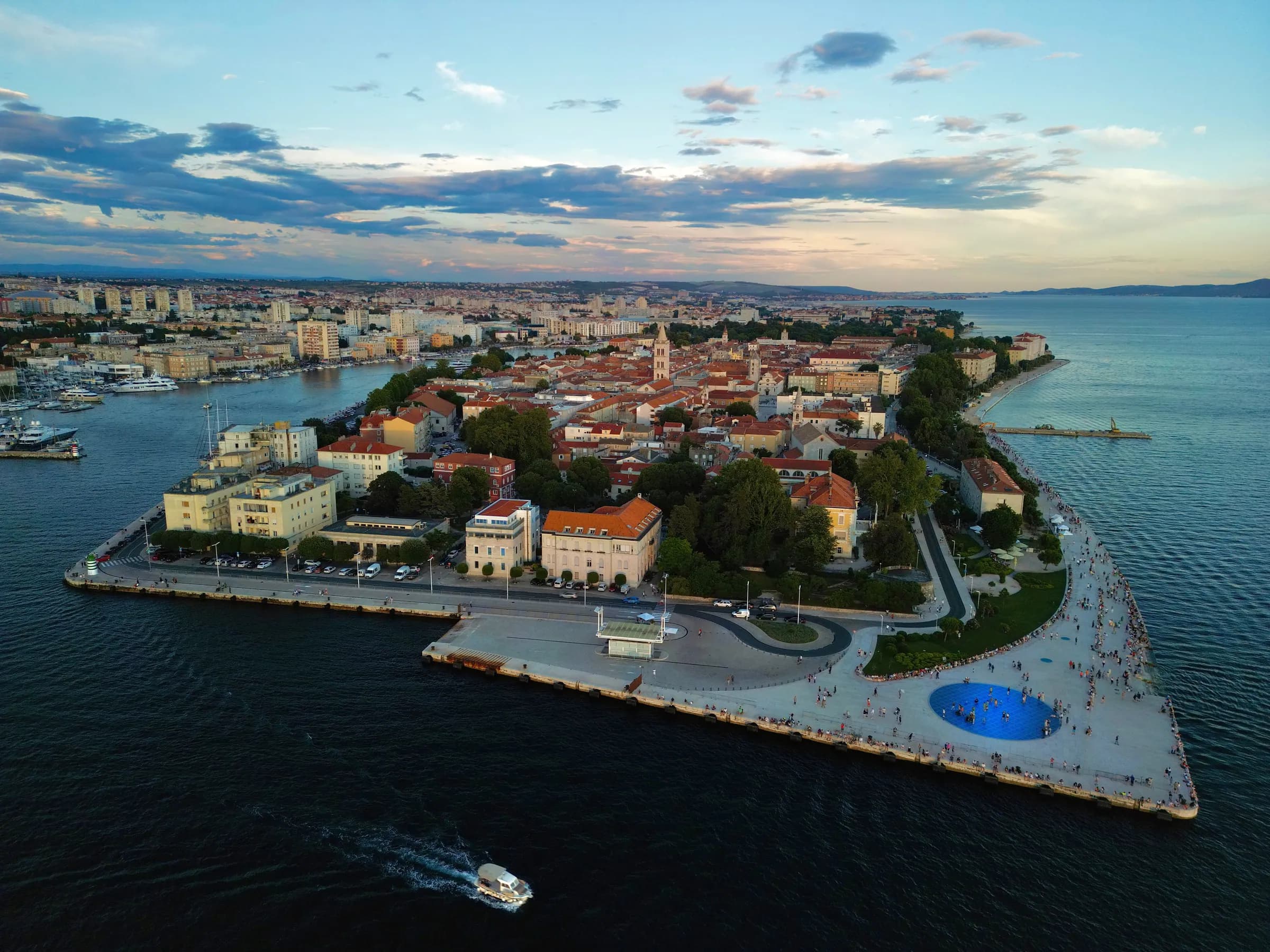
The old town sits on a small peninsula, so most of it is walkable in an afternoon: the Roman forum, St Donatus, the marble streets, and the promenade where the Sea Organ plays with the waves.
Zadar is also the usual gateway to the Kornati islands and Paklenica, and sits roughly between Split and the Plitvice Lakes — which makes it a practical stop rather than a detour.
The Sea Organ is worth understanding rather than just hearing. Steps cut into the waterfront hide pipes beneath them, and the waves push air through so the sea plays it — no two minutes sound the same, and it works in any weather. Next to it, the Greeting to the Sun is a glass circle that collects light all day and puts it back after dark.
Zadar was heavily bombed in the Second World War and rebuilt, which is why Roman columns stand next to plain modern facades in the same square. The forum is the largest on the eastern Adriatic, and much of its stone was reused in the buildings around it.
The city is the usual departure point for the Kornati islands — an archipelago of over a hundred mostly uninhabited islands — and for Paklenica, where the Velebit mountains drop to the sea in two canyons. Neither is a Zadar sight, but both are the reason people base themselves here.
We drive Zadar as a private transfer in both directions from Split, and it can be combined with Plitvice or the coastal route north on the same journey.
What to see in Zadar
The Sea Organ
Waterfront steps that play as the waves move through pipes beneath them. Free, permanently on, and better at dusk when the promenade fills.
Greeting to the Sun
A glass disc set into the quay that charges in daylight and lights after dark, alongside the Sea Organ.
The Roman forum and St Donatus
The largest forum on this coast, with a ninth-century circular church built partly from its stone standing on the edge of it.
Kalelarga
The old town's main street, marble underfoot, running the length of the peninsula and busy every evening.
Before you go
Sunset is the appointment
The Sea Organ and the Greeting to the Sun are both at their best in the last hour of light, which is also when the waterfront is fullest.
The old town is a peninsula
Everything worth seeing is within a walk, and cars are restricted. Drop-off is at the edge, not the middle.
It sits on the way, not off it
Zadar is roughly between Split and Plitvice, so adding it to a transfer costs less time than treating it as a separate trip.
The islands need their own day
Kornati and Paklenica are full-day trips from here, not additions to an afternoon in the old town.
How to get there
Door-to-door private transfers on your own schedule, with optional stops along the route.
- Split to Zadar Private TransferFrom €230
- Zadar to Split Private TransferFrom €230
- Zadar to Dubrovnik Private TransferFrom €480
- Dubrovnik to Zadar Private TransferFrom €480
- Plitvice Lakes to Dubrovnik Private TransferFrom €600
- Plitvice Lakes to Split Private TransferFrom €360
- Split to Plitvice Lakes Private TransferFrom €360
- Split to Zagreb Private TransferFrom €540
- Zadar to Zagreb Private TransferFrom €540
- Zagreb to Split Private TransferFrom €540
- Zagreb to Zadar Private TransferFrom €540
Frequently asked questions
How do I get from Split to Zadar?
A private transfer is the most direct option, door to door and on your own schedule, with the freedom to stop along the coast or inland on the way.
What is Zadar known for?
The Sea Organ and the Greeting to the Sun on the waterfront, the Roman forum, and the church of St Donatus — all within a short walk of each other in the old town.
When is the best time to see the Sea Organ?
The last hour of daylight. The Greeting to the Sun beside it lights after dark, so arriving before sunset gets you both — which is also when the promenade is at its busiest.
How long do you need in Zadar?
The old town sits on a small peninsula and is walkable in an afternoon: the Roman forum, St Donatus, the marble main street and the waterfront are all within a short walk of each other.
Can Zadar be a stop between Split and Plitvice?
It sits roughly on that route, so adding it to a private transfer costs far less time than treating it as a separate trip. Tell us where you are heading next and the stop is timed around it.
Is Zadar a good base for the islands?
It is the usual departure point for the Kornati archipelago and close to Paklenica in the Velebit mountains. Both are full-day trips of their own rather than additions to an afternoon in the old town.
Can Zadar be combined with Plitvice Lakes?
Yes. Zadar sits between Split and the inland route to Plitvice, so the two combine naturally on a private transfer with a stop planned in.
Planning a trip to Zadar?
Send us your dates and group size and we will put together a private tour or transfer that fits. You can also browse all our private tours and private transfers.
Plan a trip