
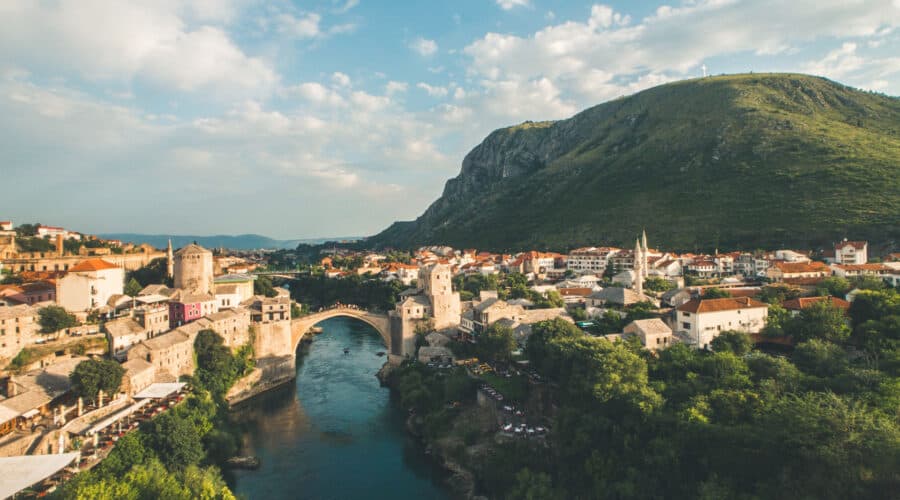
Mostar Old Town Where the Ottoman Empire Left Its Finest Mark
Stand at the centre of Stari Most and look both ways. To your left: the Kujundžiluk bazaar, where coppersmith workshops that have been on the same street since the 16th century still hammer out the same patterns. To your right: the Neretva River, cold and fast and impossibly green, cutting through limestone gorges on its way to the Adriatic. Below you: a 21-metre drop to the water, where local divers have been leaping from the bridge parapet for generations a tradition that predates tourism by several centuries. The original bridge was built in 1566 by the Ottoman architect Mimar Hayruddin, commissioned by Suleiman the Magnificent. For 427 years it stood as the longest single-arch stone bridge of its time, connecting the two banks of the city and, symbolically, the communities on either side. In November 1993, it was deliberately destroyed during the Bosnian War. The bridge you walk across today was rebuilt stone by stone, using the same techniques and the same local limestone, and reopened in 2004. In 2005, UNESCO recognised it as a World Heritage Site not just for the architecture, but for what it represents. Walking through Mostar's Old Town takes you through layers of history that are still visibly, physically present. Ottoman mosques and hammams alongside Austro-Hungarian facades alongside rebuilt war damage alongside a city very much alive and getting on with things. It is not a museum. People live here, run businesses here, worship here. That is precisely what makes it worth a full half day. Explore: Stari Most (Old Bridge) a UNESCO World Heritage Site and symbol of post-war reconciliation Kujundžiluk bazaar the oldest continuously operating market street in Bosnia and Herzegovina The Koski Mehmed Pasha Mosque with its riverside minaret and city views The Old Bazaar's artisan workshops, copper merchants and traditional carpet sellers Riverside cafés with direct views of the bridge and the divers The story of a city destroyed and rebuilt told by the streets themselves Kravica Waterfalls Bosnia's Best Kept Natural Secret Most visitors to Mostar have never heard of Kravica. That gap in knowledge is an opportunity. Forty minutes from Mostar's Old Town, the Trebižat River drops over a wide crescent of travertine into a pool of extraordinary blue-green water, surrounded on all sides by dense subtropical vegetation fig trees, oleander and thick green moss clinging to every surface. The waterfall is roughly 25 metres high and 120 metres wide, shaped like a natural amphitheatre, with the water falling in a dozen separate curtains around its rim. Kravica is not a national park and it doesn't charge national park prices. It has not been extensively developed. The swimming area beneath the falls is clean and cold, and in summer the combination of the spray, the shade and the colour of the water makes it one of the most refreshing stops on any tour in the western Balkans. It's also simply beautiful the kind of place where people arrive expecting to stay 30 minutes and end up staying two hours. Explore: One of Bosnia and Herzegovina's most spectacular natural sites, almost unknown outside the region A wide travertine waterfall amphitheatre with a swimmable pool beneath (seasonal) Lush riverine vegetation and a cool microclimate ideal for summer visits A genuine contrast to Mostar's urban intensity nature immediately after history Blagaj Tekke A Monastery Built Into a Cliff at the Source of a River For those who prefer atmosphere over activity, Blagaj offers something rarer than a waterfall: stillness. At the foot of a sheer limestone cliff, where the Buna River emerges fully formed from underground at a rate of 43 cubic metres per second one of the largest karst springs in Europe stands a small, white-walled Dervish monastery. The Blagaj Tekke was built in the 16th century, at the moment of Ottoman expansion into Herzegovina, and it has been in near-continuous use as a place of contemplation and religious practice ever since. The setting is extraordinary. The cliff rises straight from the water. The building clings to the rock face as if it grew there. The Buna runs cold and crystal clear between willow trees to a series of wooden platform restaurants where local trout is served fresh from the river. The whole place operates at a frequency several notches below the rest of the day. This is the stop for guests who want to understand Bosnia and Herzegovina rather than just see it who prefer the quieter story behind the famous photograph. Explore: The Blagaj Tekke a 16th-century Dervish monastery built into a limestone cliff The source of the Buna River, one of the largest and most powerful karst springs in Europe A site of continuous spiritual practice for over 500 years One of the most photographed and least crowded attractions in all of Herzegovina Riverside restaurants serving fresh local trout directly from the Buna