

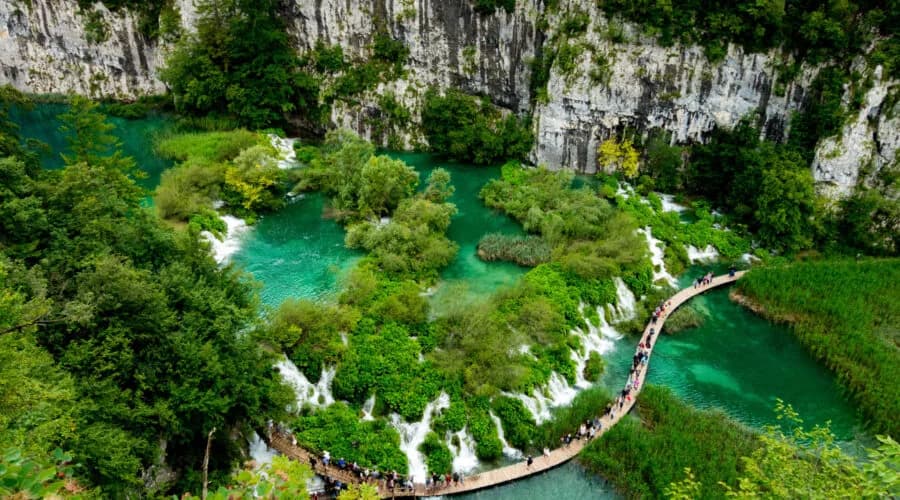
Plitvice Lakes National Park A Living Landscape That Builds Itself
The geology of Plitvice is unlike almost anything else on Earth. The water flows from mountain springs through a karst plateau, carrying dissolved calcium carbonate that deposits slowly imperceptibly slowly onto mosses, algae and fallen branches. Over thousands of years these deposits harden into travertine: a porous, pale stone that forms natural dams, which back up into lakes, which overflow into waterfalls, which deposit more travertine, which form more dams. The park you walk through today is not a finished landscape. It is a landscape still in the process of being made. There are 16 lakes in total, arranged across two levels connected by 90 waterfalls and 18 kilometres of wooden boardwalks and forest paths. The electric boat crossing between the Upper and Lower Lakes and the panoramic train ride through the park are both included with your entrance ticket no extra charges, no surprises. Lower Lakes Drama, Waterfalls and Veliki Slap The Lower Lakes section is where Plitvice reveals its most dramatic face. The gorges are narrower here, the waterfalls larger, the boardwalks closer to the water. You walk directly above cascades, feel the spray, and watch the Korana River emerge green and cold from the canyon below. At the far end of the Lower Lakes stands Veliki Slap Croatia's tallest waterfall at 78 metres dropping in a single, unbroken curtain of white water into the gorge. It is one of the most photographed natural sights in Croatia, and in person it is considerably more impressive than any photograph suggests. The Lower Lakes attract the most visitors, which is precisely why the early departure time on this tour matters. Arriving before 10:00 makes a significant difference. Upper Lakes Stillness, Forest and a Different Kind of Beauty Where the Lower Lakes are dramatic, the Upper Lakes are meditative. Twelve interconnected lakes stretch across a wide, forested valley larger, stiller, surrounded by beech and hornbeam that turn amber and gold in autumn. The water here changes colour depending on the angle of the sun and the composition of the sediment below: sometimes pale green, sometimes a deep, opaque blue that looks almost artificial. The walking pace slows naturally. People stop more. The crowds thin. Many visitors who rush through the Upper Lakes on a group tour miss what makes them worth the time: the quality of the light on the water, the silence between the falls, the gradual realisation of the scale of what you are standing inside. The Electric Boat and Panoramic Train Both Included Connecting the two lake systems are two modes of transport that are part of the experience, not just logistics. The electric boat crosses Lake Kozjak the largest lake in the park in near silence, with views across the water to the surrounding forest. The panoramic train links the upper and lower sections of the park, passing through woodland with views over the canyon. Both are included with your park entrance ticket. Your driver will advise on the best sequence for the day depending on the season and time of arrival.